01Which IPv4 services are available?
An IPv4 marketplace gives businesses one place to buy, lease, rent, sell, or monetize IPv4 address space. The right transaction model depends on whether the priority is long-term control, temporary capacity, predictable operating expenses, or income from unused blocks.
Available options can be compared by prefix size, RIR, term, transfer model, and intended use. The marketplace supports several transaction models rather than forcing every requirement into a purchase. Businesses can choose the option that matches their infrastructure plans:
- buy IPv4 addresses when the block needs to be transferred to the buyer for long-term control;
- lease IPv4 addresses when dedicated address space is required without an upfront acquisition;
- rent IPv4 for shorter projects, migrations, testing, or temporary capacity;
- monetize unused IPv4 when a holder wants recurring income without selling the asset;
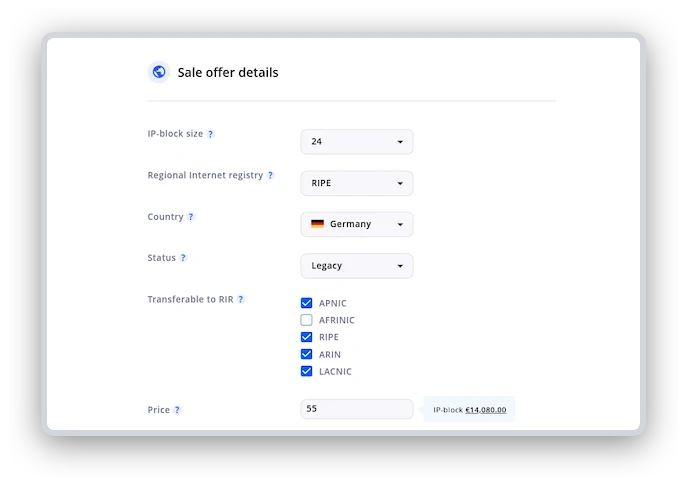
- sell an IPv4 block when the address space is no longer needed and a one-time transaction is preferable.
The platform works with blocks from /24 up to /16. A /24 contains 256 addresses, while a /16 contains 65,536, so the required prefix should be selected according to actual capacity and routing needs.
02How do buying, leasing and renting differ?
Buying transfers the address block to the buyer through the relevant RIR process. This model suits organizations that expect to retain the resource and want direct long-term control.
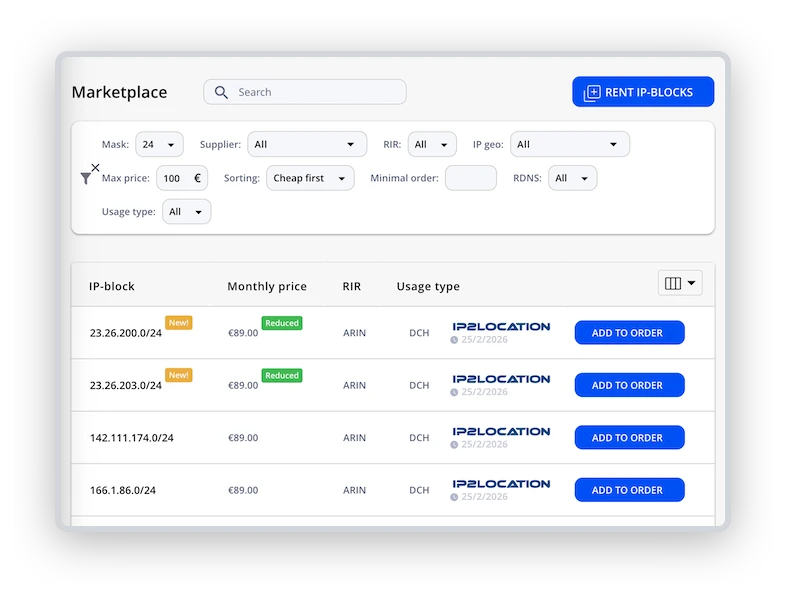
Leasing provides dedicated IPv4 space for an agreed period without requiring a purchase. Current lease options start at around €89 per month for a /24. Larger prefixes are quoted individually so that the effective per-address rate, term, region, and technical requirements can be assessed together. There are no setup charges, and LOA and assignment support are included.
Renting is intended for shorter or more temporary requirements. It can be appropriate for migration overlap, testing environments, temporary launches, or projects where permanent ownership would create unnecessary commitment.
03What should be checked before buying or leasing an IPv4 block?
An address block should be evaluated on more than price. The practical value of a subnet depends on whether it can be transferred or routed for the intended workload.
Important checks include:
- RIR and transfer path;
- block size and available capacity;
- registration and ownership records;
- previous use and reputation;
- abuse or blocklist history;
- LOA and routing requirements;
- contract term and payment conditions;
- transfer or activation responsibilities.
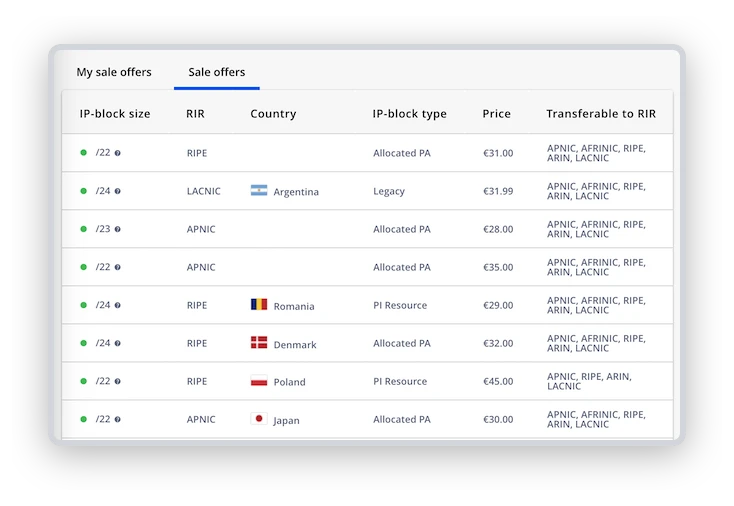
Purchase transactions may also require due diligence, escrow, and coordination with the relevant Regional Internet Registry. Blocks can originate in the RIPE NCC, ARIN, APNIC, LACNIC, or AFRINIC service regions, but the supported inter-RIR path must be checked for the specific source and recipient. For ARIN, current compatible inter-RIR counterparts are APNIC, RIPE NCC, and LACNIC. For larger or more complex purchases, escrow can be used so that funds are held until the agreed transfer conditions are completed.
04How can unused IPv4 address space generate income?
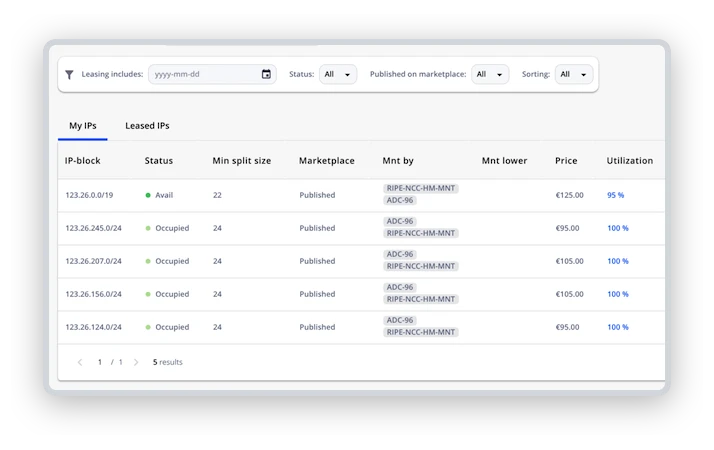
Organizations that hold unused blocks do not always need to sell them. Leasing unused prefixes can create recurring revenue while ownership remains with the holder.
Before listing a block, the holder should confirm that it is operationally available and not still referenced by production systems, customer allowlists, DNS records, firewall rules, monitoring, or other internal dependencies. Lease terms should then define pricing, permitted use, contract duration, payout arrangements, and the responsibilities of both parties.
05What support can be useful during an IPv4 transaction?
Simple transactions may require little assistance, while larger transfers can involve several commercial and technical steps. Broker support can cover block matching, due diligence, LOA preparation, escrow coordination, LIR communication, and the RIR transfer process.
A marketplace with broker support lets a buyer start by comparing available supply and request additional coordination when the transaction requires it. This is useful when a specific block size, region, transfer path, or technical condition must be matched.
06Choose the appropriate IPv4 transaction model
IPv4 requirements differ by network size, time horizon, budget, RIR, and intended use. IPv4 Online combines an IPv4 marketplace with broker support for businesses that need to buy, lease, rent, sell, or monetize address space. Submit the required prefix size, region or RIR, and preferred transaction model to receive matching options and determine the next step.