IPv4 Purchase Cost Breakdown 2026: Address Price, Escrow, Broker Fees and RIR Transfer Costs
 Giulia Marchetti
October 15, 2026
Giulia Marchetti
October 15, 2026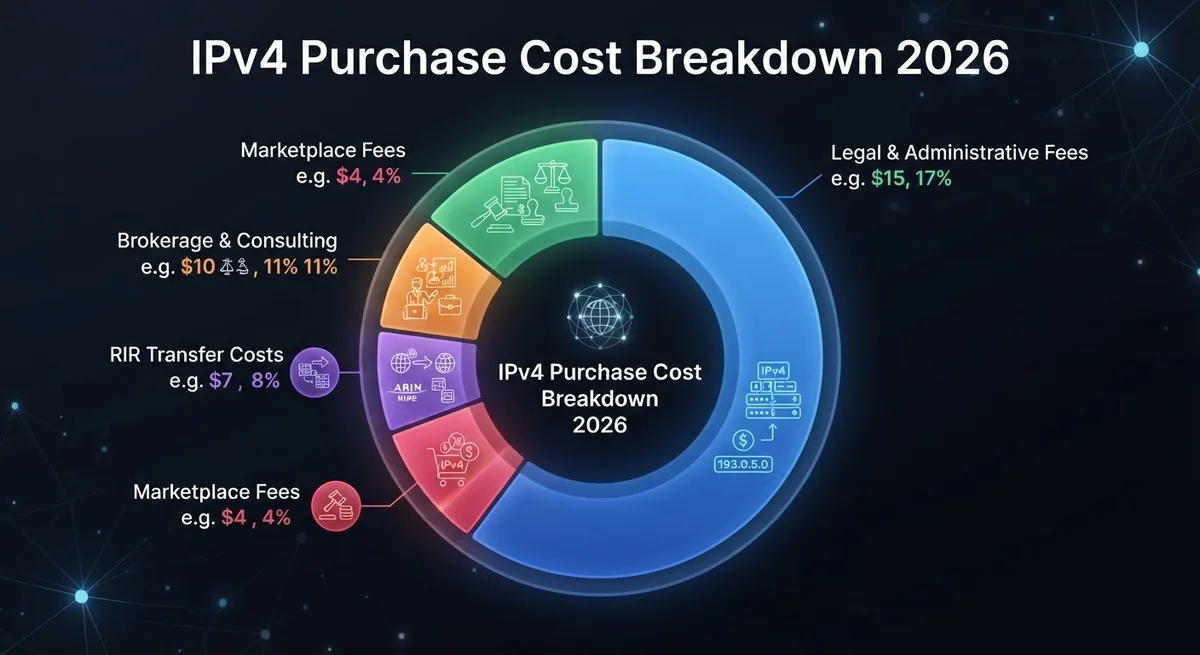 The advertised price per IP is only one part of an IPv4 acquisition budget. Companies that plan to buy IPv4 addresses should also account for escrow, broker services, RIR charges, due diligence, legal work, and post-transfer administration before comparing offers.
An IPv4 purchase cost breakdown is a structured calculation of the direct and transaction-related expenses involved in acquiring IPv4 address space. It combines the address purchase price with escrow, brokerage, registry, legal, and transfer-related charges so that the buyer can estimate the full amount required to complete and register the transaction.
What determines the IPv4 address price in 2026?
The IPv4 address price in 2026 is not a single fixed market rate. It varies by block size, RIR region, address history, reputation, transfer eligibility, and available supply.
IPv4 prices strengthened after reaching lower levels earlier in the market cycle. A typical /24 purchase can be valued at about $6,630, or approximately $25.90 per address. Larger address blocks may trade at a lower per-address rate because block size influences market liquidity, the range of potential buyers, and overall demand.
For budgeting, buyers should compare:
- block size and total address count;
- price per IPv4 address;
- RIR region;
- registration and transfer history;
- reputation and blocklist status;
- whether the quoted amount includes transaction services.
The purchase price should therefore be treated as a market-specific quote rather than a universal benchmark.
What should a purchase fee breakdown contain?
A complete purchase fee breakdown separates the asset price from the expenses required to close the deal.
| Cost component | What the buyer should check |
|---|---|
| Address price | Price per IP × number of addresses |
| Escrow | Fixed fee or percentage and who pays it |
| Broker service | Included in quote or charged separately |
| RIR charges | Registry-specific transfer or account fees |
| Legal review | Contract and ownership verification |
| Technical due diligence | Reputation, routing and registry checks |
This distinction matters because two blocks with the same per-address price can produce different purchase total costs once transfer expenses are included.
How do escrow fees affect the transaction?
Escrow protects payment while the registry transfer is being completed. The buyer sends funds to an independent escrow provider, and the money is released according to the agreed closing conditions.
Purchase escrow fees are not standardized across the IPv4 market. They depend on the escrow provider, transaction value, payment method, jurisdiction, and agreement between buyer and seller.
Before signing, confirm:
- who selects the escrow provider;
- who pays the fee;
- what event authorizes release of funds;
- how a failed transfer is handled;
- whether bank or currency-conversion charges are additional.
Escrow should appear as its own line in the acquisition budget rather than being assumed to be included in the IPv4 price.
How should broker fees be calculated?
Purchase broker fees may be charged separately, incorporated into the quoted price, or allocated to one party under the transaction agreement. There is no universal brokerage percentage for IPv4 purchases.
The buyer should ask whether the fee includes sourcing, seller verification, due diligence coordination, negotiation, escrow administration, and RIR transfer support. This prevents the same service from being counted twice in the transaction costs for 2026.
What RIR transfer costs apply in 2026?
RIR transfer costs depend on the registry and the buyer’s existing account status.
For ARIN 8.3 or 8.4 transfers, processing charges can apply to both sides of the transaction. The source organization may incur a $500 fee, while recipient charges vary by prefix size, including $187.50 for a /24, $375 for larger blocks through /22, and $750 for larger blocks through /20.
Resource transfers in the RIPE NCC service region do not carry a separate transfer charge, although the recipient may still face membership-related expenses. An LIR account requires an annual contribution of €1,800, while opening a new LIR account involves a €1,000 sign-up fee.
For IPv4 transfers in the APNIC region, recipient-side charges may apply, with some NIR cases handled differently. An initial transfer to a new account, or to an existing account without IP resources, may instead require the relevant annual membership fee before completion.
A transfer cost breakdown should therefore use the actual RIR, account type, and prefix size rather than applying one registry fee to every purchase.
How can total IPv4 acquisition costs be calculated?
A practical formula is:
Total acquisition cost = address purchase price + escrow + broker fee + RIR charges + legal and due diligence costs
For example, a /24 valued at about $6,630 represents the address value only. If that purchase follows an ARIN transfer, the buyer should separately consider the applicable recipient processing fee and any escrow, brokerage, banking, or legal expenses.
This approach gives finance teams a more accurate view of acquisition costs in 2026 than multiplying a market price by the number of addresses.
What should buyers verify before approving the budget?
Before approval, confirm:
- whether all quoted fees are gross or net of tax;
- the currency used for each payment;
- whether escrow and brokerage are included;
- which party pays RIR charges;
- whether a new registry account is required;
- whether additional legal or technical review is needed;
- which costs remain payable if the transfer fails.
The quote and purchase agreement should allocate each cost explicitly. This reduces the risk of unexpected charges during closing.
How can you calculate the full budget before buying IPv4?
Before approving a purchase, send IPv4 Online the target prefix and RIR and request a transaction-level cost breakdown. Separate address value, escrow, broker services, registry charges, banking, legal work, and technical onboarding so the budget reflects the amount needed to close.
Compare candidate blocks by total acquisition spend rather than by the advertised per-IP figure. The transaction team can coordinate sourcing and transfer steps while the buyer keeps each external cost visible as a separate line item.