Buy IPv4 addresses safely
Businesses can buy IPv4 addresses when they need long-term control of public address space and want the resource transferred through the relevant Regional Internet Registry. Purchasing is suited to infrastructure that will remain in operation for years and where recurring lease payments are less attractive than ownership.
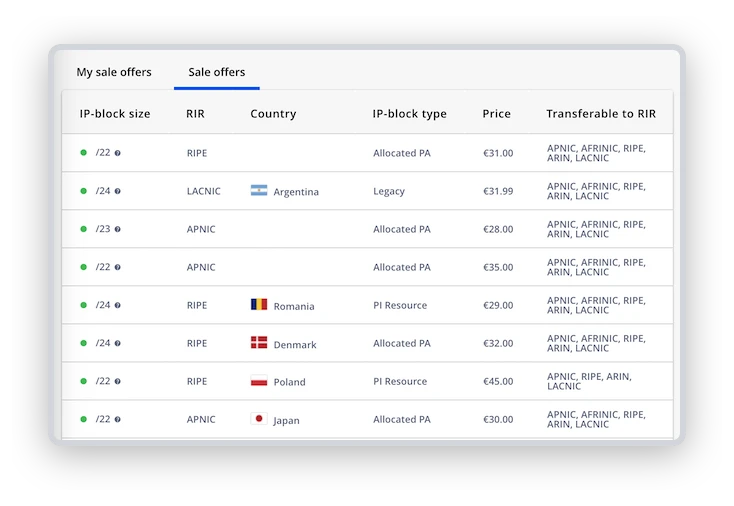
Buying IPv4 addresses is the permanent acquisition of an IPv4 block through an approved RIR transfer process. It gives the buyer long-term control of the resource, allows the range to become part of owned network infrastructure, and creates the option to route, retain, or monetize the address space after the transfer is complete.
IPv4 purchase prices and block sizes
| Prefix | IPs | Price | Action |
|---|---|---|---|
| /24 | 256 | From €25/IPone-time | Get a quote |
| /23 | 512 | From €25/IPone-time | Get a quote |
| /22 | 1,024 | From €23/IPone-time | Get a quote |
| /21 and larger | 2,048+ | From €20/IPone-time | Get a quote |
Blocks may be sourced from the RIPE NCC, ARIN, APNIC, LACNIC, and AFRINIC service regions. The actual transfer path must be verified for the specific source and recipient RIRs; not every inter-RIR pair follows the same policy or is available in both directions.
The exact purchase amount depends on the selected prefix, RIR region, block history, market supply, and transaction conditions.
If ownership is not required, leasing IPv4 addresses reduces the upfront commitment. An owned block can later be monetized through leasing if part of the capacity becomes temporarily unused.
What should be checked before buying IPv4?
A purchase should include administrative and technical due diligence before funds are committed.
Important checks include:
- seller identity and authority to transfer the resource;
- RIR registration and transfer eligibility;
- WHOIS and RDAP records;
- route history;
- reserved or bogon status;
- reputation and blocklist records;
- transaction and authorization documents.
The selected prefix should also reflect expected capacity. A /24 contains 256 addresses, a /22 contains 1,024, and a /21 contains 2,048.
What is an LOA?
A Letter of Authorization (LOA) is a signed document that authorizes the RIR to process the transfer of the IPv4 block from seller to buyer. We (as broker) help coordinate the LOA as part of the process.
How does an IPv4 purchase proceed?
Select a suitable block
Verify ownership and eligibility
Agree on commercial terms
Prepare the documents
Submit the RIR transfer
Complete registration
After transfer, the block can be announced through the buyer's network providers, retained for future capacity, or used for supported BYOIP deployments.
When is buying more practical than leasing?
Buying is suitable when the range is expected to remain part of the infrastructure for the long term. Ownership removes lease-renewal risk and gives the business more control over future use of the resource.
Leasing can be more appropriate when demand may change, the project has a limited lifecycle, or the organization prefers recurring operating expenditure over a larger initial investment.
Buy vs lease
| Feature | Buy | Lease |
|---|---|---|
| Ownership | Full — RIR transfer to you | No — holder retains |
| Upfront spend | High one-time payment | Usually none |
| Typical term | Permanent | 1 month – 3+ years |
| Recurring cost | None after purchase | Monthly or quarterly |
| Flexibility | Low — you own it | Moderate — renew or return |
| Best for | Long-term infrastructure | Dedicated use without buying |
Common buy use cases
Cloud and hosting
Enterprise infrastructure
VPN and proxy
Investment or lease-out
Frequently asked questions
What is the smallest IPv4 block commonly purchased?
Do I need an LIR to buy IPv4?
Is the indicative price the final transaction amount?
What can be done with the block after transfer?
Plan your IPv4 acquisition
Contact IPv4 Online with the required prefix, RIR region, intended use, and transfer requirements. The team can help identify suitable address space, verify the transaction path, and coordinate the acquisition through to completion.