Skip to content
Fresh IPv4 news just dropped — 🎉 see what you’re missing

Lease IPv4 addresses

Businesses can lease IPv4 addresses when they need dedicated public address space without purchasing a block. Leasing suits hosting, cloud infrastructure, customer assignments, VPN and proxy services, VoIP, cybersecurity systems, and enterprise networks where stable IPv4 capacity is required for months or years.

Lease IPv4 addresses

IPv4 leasing is a service that gives a business temporary, dedicated rights to use an IPv4 block while ownership remains with the holder. It allows companies to obtain public address space for a defined term, control infrastructure costs, and avoid the larger upfront commitment required for a permanent IPv4 purchase.

/24 ··· /16
Block sizes available
250 000+
IPv4 addresses in stock
1 month – 3+ years
Flexible contract terms

IPv4 lease prices and available blocks

PrefixIPsPricePrice per IPAction
/24256€85/mo€0.33/moView available blocks
/23512€190/mo€0.37/moView available blocks
/221,024€419/mo€0.41/moView available blocks
/212,048€840/mo€0.41/moView available blocks
/20 and larger4,096+€1680/mo€0.41/moView available blocks

Blocks are available from /24 to /16, with more than 250,000 IPv4 addresses in inventory. Contract terms can range from one month to three years or longer. Reputation, geolocation, route history, blocklist status, and permitted use may also affect subnet selection.

For projects lasting only a few weeks or months, rent IPv4 addresses may provide more flexibility. If the range will become part of permanent infrastructure, buying IPv4 addresses can eliminate recurring lease payments.

How does IPv4 leasing work?

Step flow 1 4

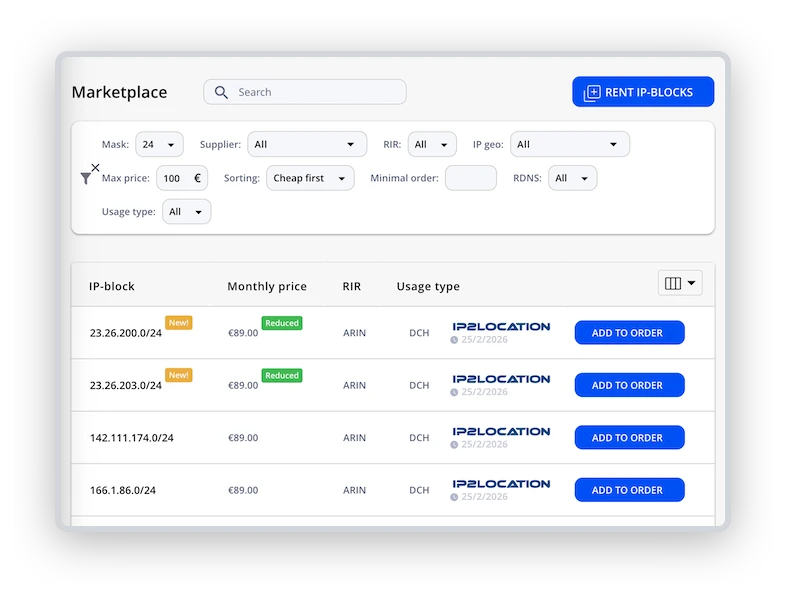
Define requirements

  • Define the required prefix, region, contract period, and intended use.
  • Decide whether geolocation, route history, IP reputation, and hygiene constraints matter for the workload.
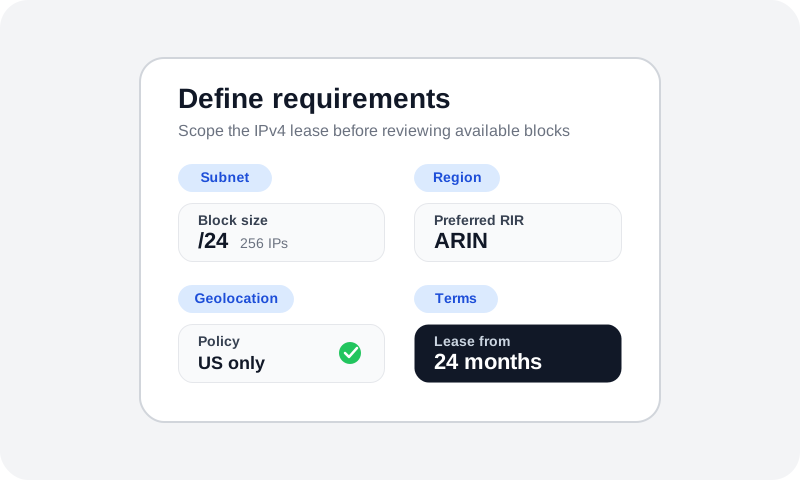
Requirements for leasing IPv4 with subnet size, region, geolocation, and lease term
SubnetRegionGeolocationTerms

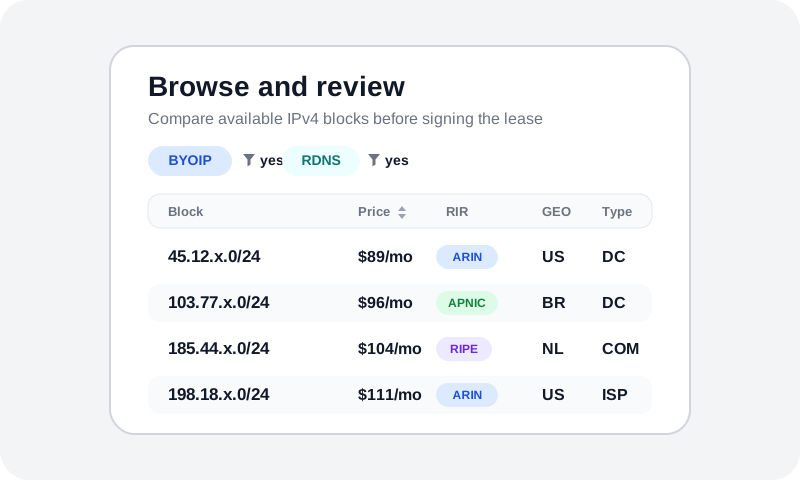
Browse and review

  • Review suitable blocks and their usage conditions.
  • Match available blocks to your technical and commercial requirements.
IPv4 lease inventory table with block, dollar price, RIR badge, geolocation, and usage type
ContractPricingBlacklist monitoringUsage policy

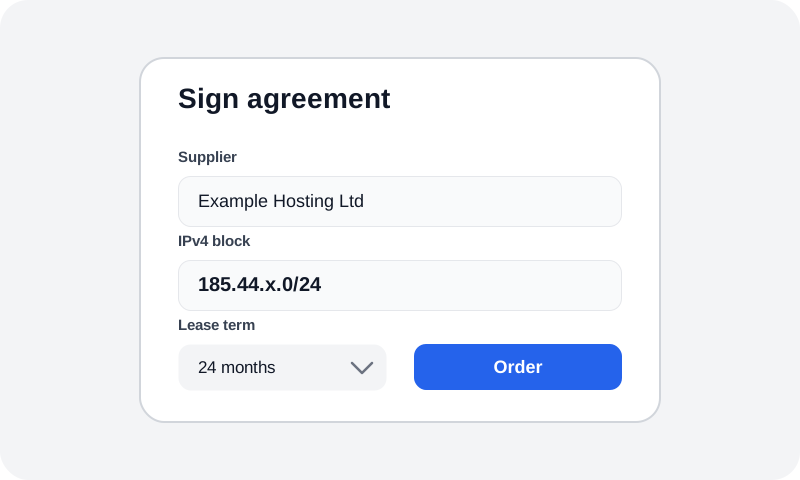
Sign agreement

  • Agree on pricing and acceptable use, and confirm the activation timeline.
  • Prepare LOA, ROA, RPKI, and routing where required.
IPv4 lease order form with company, block, lease term, and blue Order button
AgreementLOAROARPKI

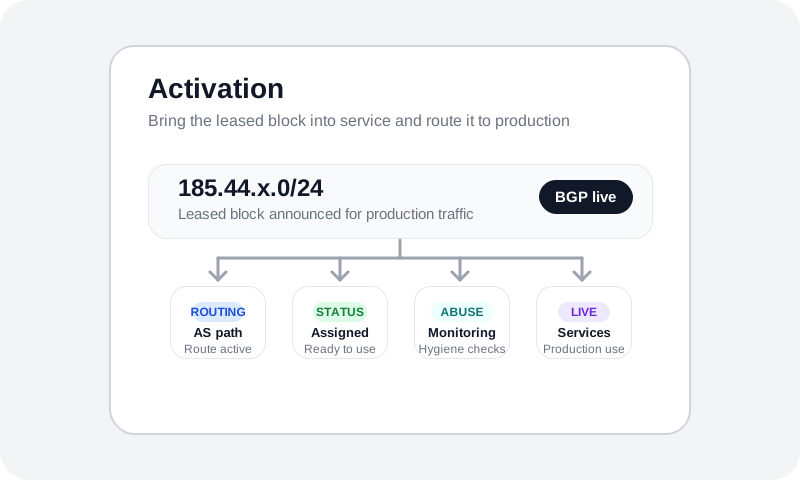
Activation

  • Activate the range and announce it through BGP.
  • The holder retains ownership throughout the contract, while the customer receives dedicated usage rights for the agreed period.
Active leased IPv4 block with BGP route, assignment active status, abuse monitoring, and production services
RoutingAssignment activeAbuse controlProduction use

Use leased IPv4 for BYOIP in AWS, Google Cloud, and Azure

  • AWS

    A common fit when AWS public IPv4 charges become large enough to justify bringing your own range for EC2, Elastic Load Balancing, NAT Gateway, EKS, or ECS.
  • Google Cloud

    A good option when you want your own public range in Google Cloud for Compute Engine, GKE, Cloud Load Balancing, or Cloud NAT instead of expanding on provider-assigned IPs.
  • Azure

    Useful when Azure public IP costs keep growing across Virtual Machines, Load Balancer, NAT Gateway, or Azure Firewall and you want a dedicated range under contract.
Compare BYOIP options
Three BYOIP provider cards for AWS, GCP, and Azure

When does leasing make sense?

Use case 01

Cloud and hosting

Lease when you need address space for BYOIP, customer allocation, or extra capacity now, but do not want to buy a block yet.
Use case 02

VPN and proxy

Teams often lease when range history, dedicated use, and the ability to keep the same space for the contract term matter operationally.
Use case 03

Enterprise networks

A practical option for branch rollouts, infrastructure expansion, or projects that will run for months or years but do not justify a purchase.
Use case 04

VoIP

Providers use leased space for SIP platforms, trunks, and telecom workloads where stable public addressing matters more than short-term flexibility.
Use case 05

Cybersecurity

Useful for internet-facing tools, threat research, and security operations that need dedicated public IP space without taking on a capital purchase.
Use case 06

Marketing infrastructure

Some teams lease ranges for landing pages, campaign infrastructure, and ad operations where stable public IP allocation is part of the setup.

Leasing is practical when address space is required for stable operations but permanent ownership is unnecessary. It can support cloud BYOIP, hosting, SIP platforms, customer pools, enterprise expansion, and security infrastructure.

A leased range can also be used with supported BYOIP solutions when the cloud platform, prefix, and routing configuration meet the required conditions.

Before signing, review renewal rules, notice periods, permitted use, replacement conditions, and the procedure for returning the block.

Lease vs buy vs rent

FeatureLeaseBuyRent
OwnershipNo — holder retainsFull — RIR transfer to youNo — holder retains
Upfront spendUsually noneHigh one-time paymentUsually none
Typical termMonths to yearsPermanentUsually shorter
Recurring costMonthly or quarterlyNone after purchaseMonthly
FlexibilityModerate — renew or returnLow — you own itHigh — short commitments
Best forStable use without purchaseLong-term infrastructureShort-term demand

Why lease instead of buying?

Buying ties up budget

If you need addresses for operations, not as an asset, leasing keeps cash free for the rest of the business.

Purchases take longer to close

Buying usually means a formal RIR transfer. Leasing is lighter operationally, so you can often get into service faster.

Demand may change

Not sure how long you’ll need the addresses? Leasing gives you flexibility to scale up or down at renewal.

Once the block is live, treat it as leased inventory, not as space you own. Track the return date, who may announce it, and who owns geofeed and reputation — the operational checklist is in IPAM for leased space.

Frequently asked questions

What is the smallest IPv4 block available for lease?
Most requirements start with a /24, which contains 256 IPv4 addresses. Larger blocks up to /16 are also available.
How long can an IPv4 lease last?
Terms can start from one month and extend to three years or longer, depending on the agreement.
Does leasing transfer ownership?
No. The holder keeps ownership, while the lessee receives the right to use the range during the contract term.
Can leased IPv4 be used for BYOIP?
Yes, where the cloud provider, prefix, routing configuration, and authorization requirements support BYOIP.

Request IPv4 capacity for your infrastructure

Contact IPv4 Online with the required block size, region, intended use, and expected term. The team can match the requirement with suitable address space and coordinate the commercial and technical stages needed to bring the range into service.