Turn your IPv4 block into income
Organizations with unused address space can monetize IPv4 by leasing a block to another business instead of selling it. This approach can create recurring income while preserving ownership and the ability to recover the resource after the contract ends.
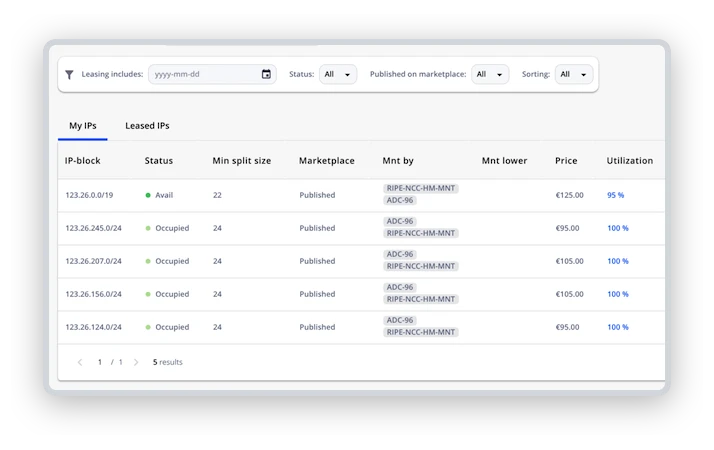
IPv4 monetization is the process of generating recurring revenue from unused IPv4 address space by leasing it to a tenant while the holder keeps ownership and RIR registration. It allows idle network resources to produce income without requiring a permanent sale of the block.
How does IPv4 monetization work?
Confirm ownership
Set terms
Match with a lessee
Activate the range
Receive payments
Typical agreements can run for 1–3 years or longer, with payments structured monthly or quarterly according to the contract.
Before leasing the resource, confirm that the block is not still connected to production systems, customer allowlists, DNS records, firewall rules, disaster-recovery plans, or other internal dependencies.
Lease out IPv4 or sell the block?
| Parameter | Lease out IPv4 | Sell IPv4 |
|---|---|---|
| Ownership | Retained | Transferred |
| Payment | Recurring | One-time |
| Typical term | 1–3+ years | Permanent |
| Future reuse | Possible | No |
| RIR registration | Remains with holder | Moves to buyer |
The choice depends on whether the priority is recurring income or a permanent exit. If the organization no longer expects to need the range, selling IPv4 addresses may be more suitable. If future reuse remains important, leasing preserves that option.
Holders can also review how businesses lease IPv4 addresses to understand tenant expectations around contract length, routing, reputation, and permitted use.
What determines IPv4 leasing income?
There is no universal rate for monetizing every block. Revenue depends on prefix size, RIR region, market demand, address history, contract duration, and lease conditions.
The agreement should define:
- rate per address or block;
- monthly or quarterly payment schedule;
- contract term;
- acceptable use;
- routing responsibilities;
- abuse handling;
- renewal and termination rules;
- return of the address space.
The relevant metric is net income after fees and any internal operating costs, not only the headline lease rate.
When is monetization appropriate?
Enterprises with spare space
Holders who may need the block again
Predictable income over a lump sum
Monetization is suitable when the organization has spare address capacity but does not want to dispose of it permanently.
The holder should compare the proposed contract period with expected internal demand. A block that may be required again soon should not be committed to a long-term lease without a capacity plan.
Frequently asked questions
Do I keep ownership when I lease out IPv4?
How long can a monetization contract last?
How can payments be structured?
Can I use the block again after the lease?
Turn unused address space into recurring revenue
Contact IPv4 Online with the prefix, RIR, current use status, and preferred contract period. The team can assess the block, help structure suitable lease terms, coordinate tenant matching, and support activation while ownership remains with the holder.